




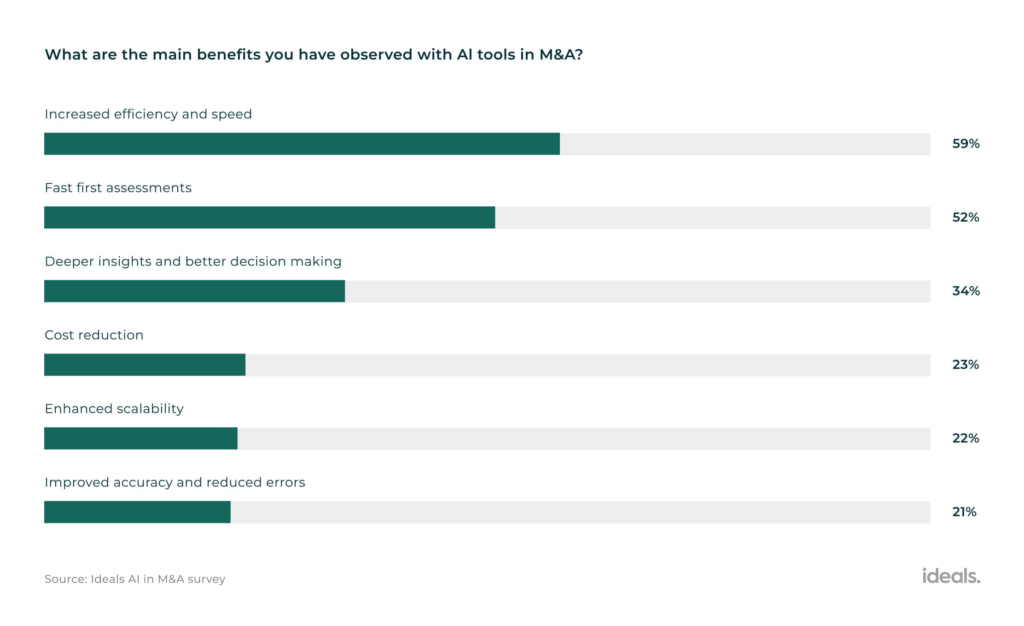
Artificial intelligence is no longer experimental in M&A — it has become a true deal accelerator. New data published in Ideals’ AI in M&A 2026 report reveals that 59% of dealmakers cite increased speed and efficiency as AI’s leading benefit, followed by fast first assessments (52%) and better decision making (34%).
The report combines survey insights from over 100 M&A professionals with profiles of leading dealmakers. The findings show how AI is being applied across the M&A lifecycle to streamline tasks, sharpen analysis, and allow teams to focus on the decisions that drive successful transactions.
Below are key takeaways from the report. For the full analysis, download the report here.
Cutting target screening from days to hours
Deal sourcing, once slow and labor-intensive, is becoming far more efficient thanks to AI. By automatically consolidating and analyzing data from multiple sources, dealmakers can quickly pinpoint opportunities.
Niko Nalli, co-founder and CEO of Comparables.ai, explains how his firm uses natural language processing and contextual search to match companies based on qualitative and financial criteria. Dealmakers can filter by growth, profitability, geography, and other metrics to produce faster, more focused analyses.
“When we benchmark against standard research methods, our customers find that Comparables delivers 110% more relevant results and cuts analysis time by up to 20x,” Niko says.
Bethany Winsby, Senior Consultant at Deloitte, sees similar efficiency gains in mid-market deal origination. “AI helps by extracting comparable metrics and spotting patterns, like unusual growth or potential customer concentration. Where there are gaps, it can build proxy assumptions using similar businesses and broader market context,” she explains.
After reviewing the AI outputs, Bethany feeds them directly into her workflow. “It cut what would have taken days down to a few hours,” she notes.
Unearthing opportunities at scale
AI also helps teams explore broader markets and emerging sectors, uncovering opportunities that might otherwise be missed. The report reveals that only 22% of dealmakers currently use AI for sourcing, yet 66% identify “finding relevant targets” as the top area where AI could add value.
Emre Ertürk, Associate Director at Odin Financial, works across Turkey, the Middle East, North Africa, and Central and Eastern Europe, where information is often fragmented. “It’s difficult to check every fund’s criteria or geographic mandate manually,” he says. “AI helps us craft prompts that match the right funds with the right opportunities.”
Using DeepSeek, Emre can screen up to 2,000 companies at once, quickly capturing those that meet growth criteria.
AI helps us craft prompts that match the right funds with the right opportunities.
Emre Ertürk, Associate Director at Odin Financial
AI also helps his team explore early-stage startup ecosystems. “There are thousands of companies in accelerators and corporate innovation programs,” Emre explains. By applying precise prompts, his team can identify which companies have matured beyond incubation. “I used to spend weeks on manual research. Now I spend more time speaking with investors,” he adds.
Making due diligence faster and more precise
Due diligence is one of the most intensive stages of M&A. The report reveals that 70% of dealmakers are frustrated by slow or incomplete data delivery, 61% struggle with poor-quality financials, and 53% face difficulties evaluating information and identifying gaps. AI is tackling these bottlenecks.
Neal Monga, Principal at NMS Capital, notes, “Everything from starting a CIM review to analyzing a virtual data room (VDR) can now be processed much faster with AI. What used to take days with a full deal team, I can now do solo.”
Setting up and organizing the VDR is another common challenge, cited by 30% of respondents. Nataliya Nagorna, Senior Product Manager at Ideals, explains how AI enables teams to streamline this process: “People want AI to help them find information across messy or inconsistent VDRs. Features like intelligent search and document summarization save time and reduce manual effort.”
What used to take days with a full deal team, I can now do solo.
Neal Monga, Principal at NMS Capital
The report also includes an interview with Marta Vizcaíno Martín, founder of TetraxAI, who emphasizes AI’s role in surfacing critical but easily overlooked risks. Her company’s platform allows energy deal teams to review large volumes of technical and legal documents in a fraction of the time.
She recalls a deal from her time as a lawyer that collapsed just before closing because trucks could not reach the construction site due to road closures. This detail was lost amid a huge volume of documents.
By detecting risks sooner, AI enables teams to focus on resolving issues and managing stakeholders effectively, increasing the likelihood of a successful transaction.
Increasing speed without sacrificing rigor
A recurring theme in the report is that AI allows deal teams to move faster without compromising the analysis that underpins successful transactions.
“AI is like having an analyst who can instantly process thousands of data points, flag risks, and highlight opportunities,” says Niko Nalli. “It doesn’t replace judgment. It accelerates the work that leads to smarter decisions.”
For a deeper look at how dealmakers are using AI to accelerate M&A, download the Ideals AI in M&A 2026 report.