




M&A deals are moving faster. But new research from Ideals suggests that shorter timelines are not the result of simpler transactions; they reflect a shift in how dealmakers prepare and execute in a more challenging environment.
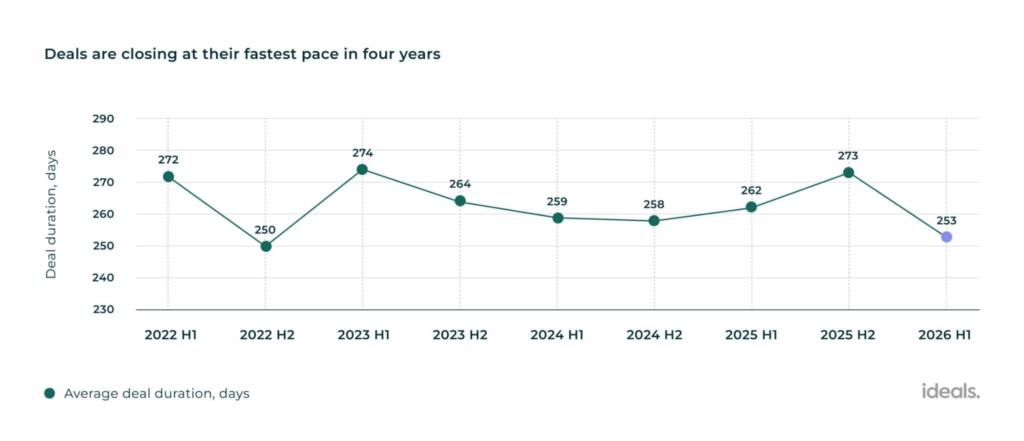
The Ideals M&A Mid-Year Review 2026 shows that transactions completed through the Ideals Virtual Data Room (VDR) during H1 2026 took an average of 253 days to close, the shortest timeline since 2022.
However, speed has not come at the expense of diligence. The average time spent in the data room increased 8% year-over-year, reaching 237 hours per transaction.
The findings suggest that dealmakers are no longer waiting for perfect conditions before moving forward. Instead, they are adapting their processes to operate effectively in a market where uncertainty has become a permanent factor.
Faster deals require deeper preparation
For much of the past two years, M&A activity has been shaped by caution. High interest rates, geopolitical disruption, and valuation uncertainty encouraged buyers and sellers to delay decisions while waiting for stability.
That approach is now changing. As financing conditions strengthen and confidence returns, the focus has shifted from whether deals can happen to how effectively they can be executed.
“Financing is no longer the biggest obstacle to getting deals done,” says David Acharya, Managing Partner at Acharya Capital Partners. “Buyers are paying more attention to diligence, contract quality, and earnings normalization.”
The greater emphasis on these elements may be what’s driving the 8% increase in VDR time, according to Ideals’ research, even as the window to close narrows. Rather than reducing the amount of work required, deal teams appear to be completing more analysis within a tighter timeframe.
Buyers are paying more attention to diligence, contract quality, and earnings normalization.
David Acharya, Managing Partner at Acharya Capital Partners
This has created a new challenge for M&A professionals: moving faster while resolving the most important valuation, diligence, and risk issues as early as possible.
Deal complexity is replacing capital as the biggest challenge
While capital availability is helping to support M&A activity, it cannot address all the sources of friction.
This is particularly visible in sectors where assets are harder to evaluate or where assumptions around future performance are changing.
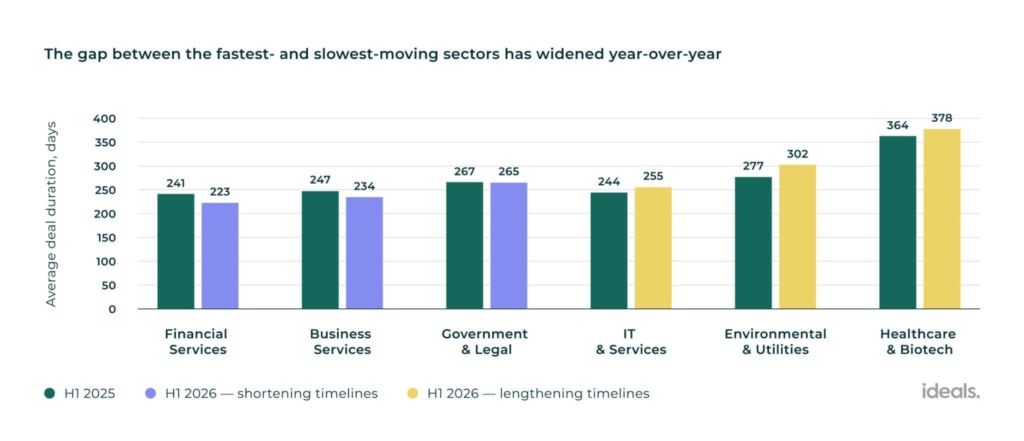
Healthcare & Biotechnology transactions recorded some of the longest timelines in Ideals’ data, with deals completed in H1 2026 taking an average of 378 days to close as buyers applied greater scrutiny to growth expectations. Technology transactions are also under pressure as shifting views on AI reshape valuations and risk assessments.
Maurice Harbison, Partner at Carlsquare, a global technology investment bank, highlights the impact of this: “The tech M&A market has experienced a structural, value-driven reset around the AI ecosystem, with the software sector particularly impacted by valuation pressures and increased compliance-related risk premiums.”
The tech M&A market has experienced a structural, value-driven reset around the AI ecosystem.
Maurice Harbison, Partner, Carlsquare
Execution challenges are also evident in the industrial market, although conditions vary significantly across subsectors. Marc Potel, Head of Industrial M&A at Investec, says activity is diverging across areas such as construction, defense, and industrial components.
“The building and construction sector is still struggling, but it feels like we’ve reached a trough. Defence, on the other hand, is very positive, while industrial component companies are feeling more bullish than earlier in the year.”
Defence is very positive, while industrial component companies are feeling more bullish than earlier in the year.
Marc Potel, Head of Industrial M&A, Investec
As financing becomes less of a constraint, execution increasingly depends on navigating the sector-specific risks and valuation challenges that define each deal.
AI is reshaping the M&A workflow
Rather than eliminating complexity, AI is helping deal teams manage increasingly demanding workflows.
The Ideals AI in M&A 2026 research found that 59% of dealmakers cite faster execution and improved efficiency as the primary benefits of using AI.
Nitin Premchandani, Senior Director in PwC’s Infrastructure M&A Advisory team, says: “At any given time, I may be working across several live processes, each requiring a detailed understanding. AI helps me process and prioritize information more efficiently, so I can focus on the issues that matter most to clients and communicate with greater clarity.”
AI helps me process and prioritize information more efficiently, so I can focus on the issues that matter most to clients and communicate with greater clarity.
Nitin Premchandani, Senior Director, Infrastructure M&A Advisor, PwC
As adoption increases, AI could help deal teams manage growing complexity while creating further opportunities to improve transaction efficiency.
The new rules of deal execution
As Deven Monga, VP of Sales at Ideals puts it: “Dealmakers have stopped waiting for perfect conditions because they’ve accepted that those aren’t coming back. What separates the deals that close from those that stall isn’t timing, but execution: speed, structure, and a clean path to completion.”
In a market where uncertainty is all but guaranteed, the ability to execute effectively will become a defining advantage.
Dealmakers that prepare earlier, manage complexity efficiently, and use technology to support decision-making will be best positioned to turn opportunities into completed transactions.
Explore the full analysis in the Ideals M&A Mid-Year Review 2026.