

 Harsh Batra
This week, the National Stock Exchange (NSE) teed off its plans for a $2.5 billion IPO by courting investment bank interest for pitches.
Further, fresh capital is rumoured to be targeting underserved corners of the housing market: Motilal Oswal Home Finance signed a $100 million deal with the Asian Development Bank (ADB) to fund green, women-focussed home loans, signalling how global money could fuel inclusive growth.
Meanwhile, the consumer space has a promising and upcoming listing of Milky Mist as the dairy aims to grow by focussing on high-margin value-added products.
And finally, India’s banks got a go ahead for deeper ties with global players as a domestic lender got the regulatory go ahead to boost its stake in Generali Insurance Ventures.
I hope you enjoy this week’s roundup – please connect on LinkedIn to discuss how Ideals VDR can help with your next M&A deal.
Let’s dive in.

Deal Tracker
Our weekly roundup of confirmed M&A deals in the UK.
Market Trends
The AI data centre glut: What is ‘inference’?
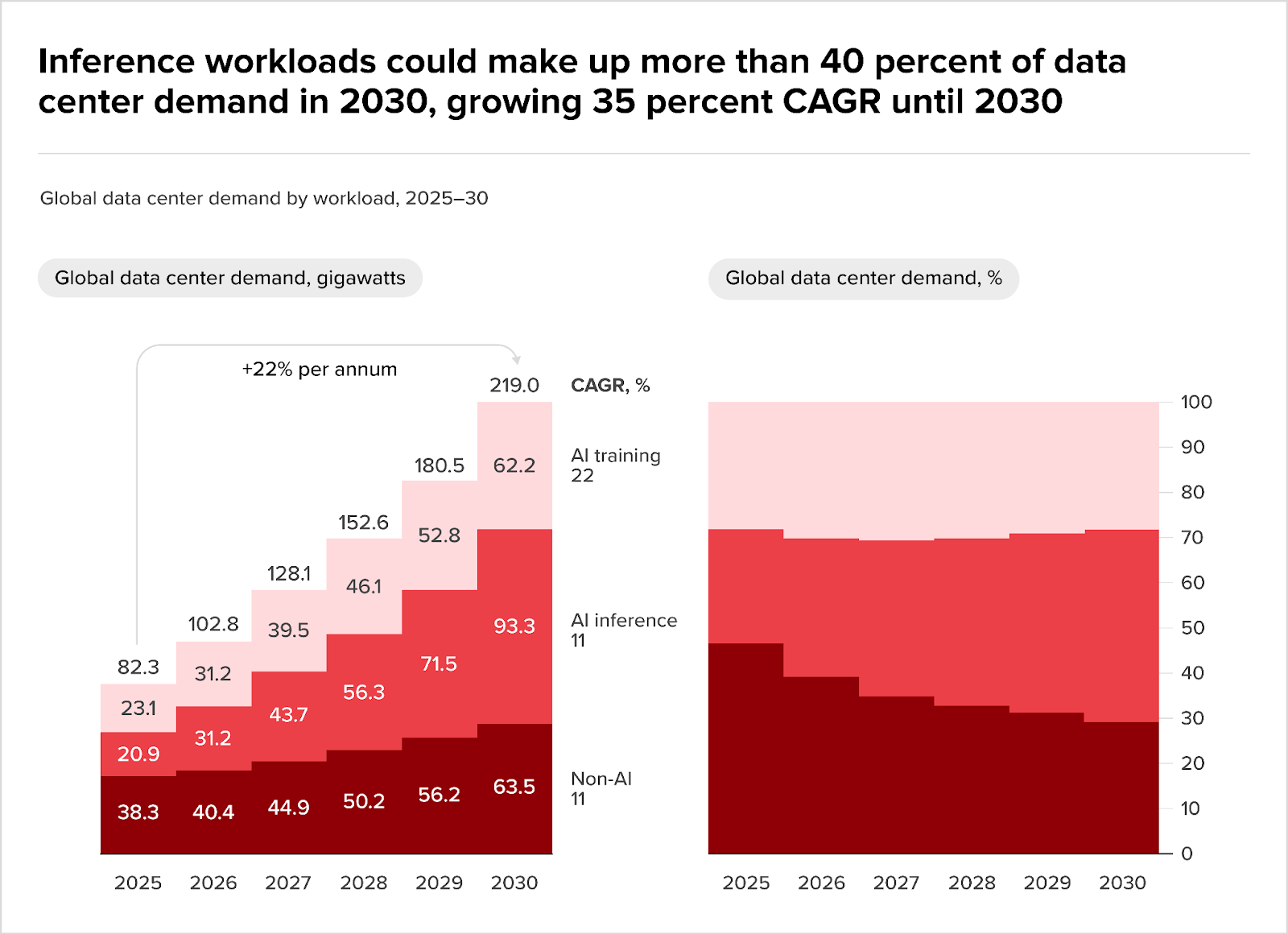
A report by financial advisory McKinsey showed up to suggest how different AI ‘workloads’ might reshape global data centre demand in the next decade. And though you may say there is already too much hype around AI, this set is, nonetheless, noticeable.
The world’s data centre capacity, it says, could expand from 82 gigawatts to 219 gigawatts by 2030, roughly about 20% growth (CAGR). Much of this expansion will come from ‘AI inference workloads’ – systems that make predictions in real time such as, but not limited to, chatbots, recommendations, and automated decision making – projected to grow significantly faster than AI training and traditional computing demand by just over a third (35%) annually.
‘Inference’ may in fact become the most expensive and valuable segment of the AI/tech supply chain. Operators, semicon and cloud providers see opportunities, especially as businesses expand AI deployment. Naturally, consolidation, partnerships, and strategic acquisitions will come, as companies forage compute capacity.
Meanwhile hyperscalers are hunting for high-performance computing assets for AI chips.
AI-style investment (2013–2024)
What’s driven the growth in AI investment? Venture capital and growth equity have been hot on AI since startups first started spouting new language models, and the government has been targeting more tech infra capex, and don’t forget the many private sector bets on enterprise apps.
The major spike occurred around 2021 when global corporate investment peaked at over $360 billion, driven by aggressive VC and tech firm funding (or, strategic bets).
Investment then cooled in 2022-23 amid tighter financial conditions; then a rebound in 2024 suggested that AI may be among the more resilient investment themes.
From an M&A perspective, Quid’s data indicates acquisitions remain a relatively small but strategic portion of AI investment activity (minority stakes, no full-on commitment to ‘full integration’). Corporates acquired startups not for scale but for AI talent, new models, and specialized tools to accelerate their own capabilities.
For dealmakers, the data suggests the AI sector will likely follow a familiar pattern: venture-led experimentation followed by consolidation. As funding cycles mature and competition intensifies, larger tech firms and PE expect to acquire promising AI startups to build platforms, whole ecosystems, the whole lot.
Where will demand stem from?
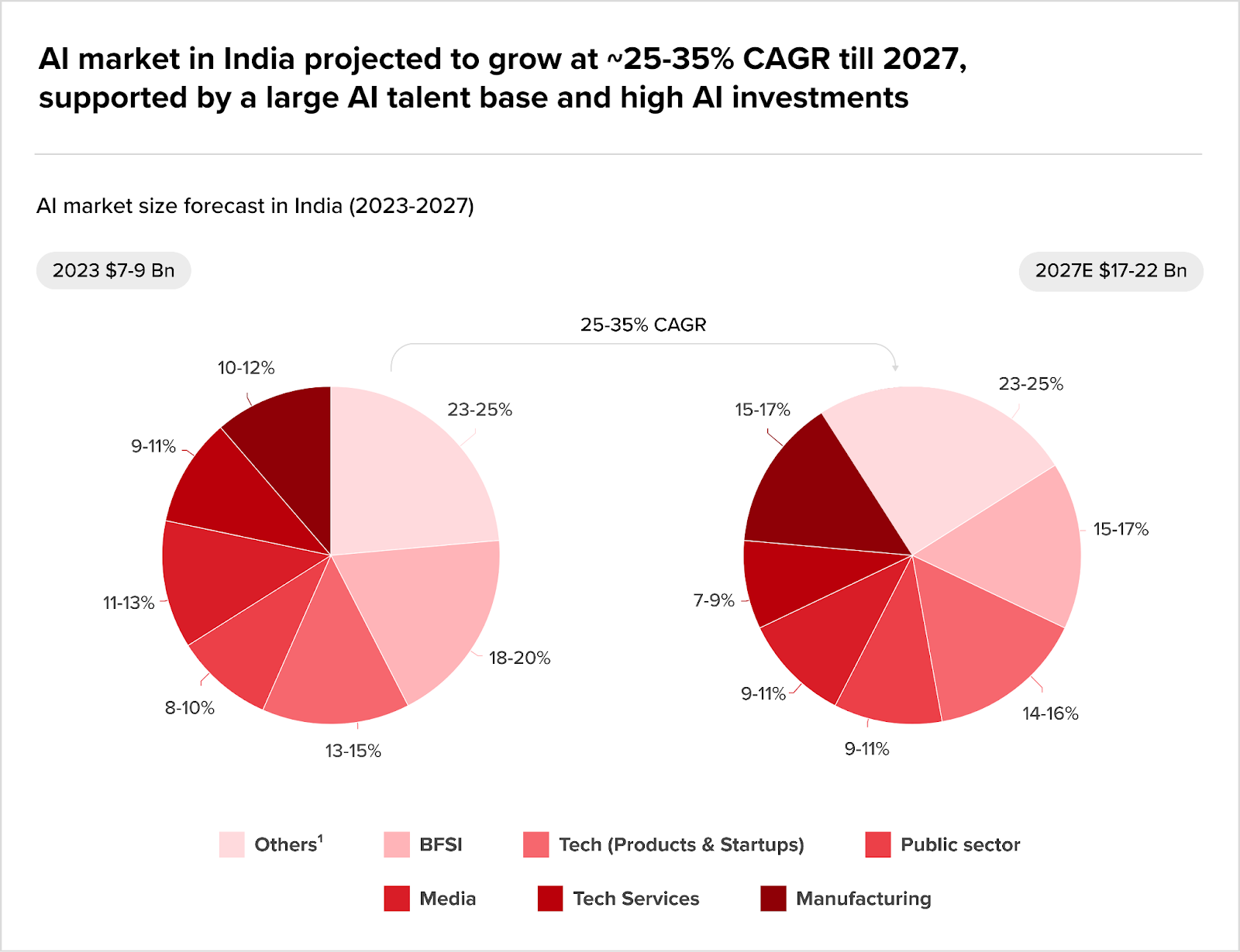
The rapid expansion of the Indian AI market will benefit from a convergence of factors: a large technical workforce, a massive digital consumer base, and increasing enterprise demand for automation and analytics.
Fintech is lapping it up, accounting for roughly 18-20% of AI demand in 2023 and will remain dominant if banks deploy AI for credit scoring, fraud detection, and customer engagement.
Tech startups may also represent a portion of the market, using AI to power software development, cloud services, and platform businesses.
Public sector adoption is expected to increase significantly by 2027 as governments deploy AI for governance, healthcare delivery, and infrastructure planning.
The McKinsey study also gives an honorable mention to the media industry as a prominent AI adopter as content generation tools mature.
The ‘seven pillars’ of Indian AI
The IndiaAI Mission has been eating at the periphery of our attention as the government seems open and looks to modernise, and cultivate AI assets – human and machine – to build a stronger India.
It’s chosen ‘seven pillars’ for expanding computing power, creating shared datasets, training skilled workers, funding startups, and supporting research and real-world AI applications.
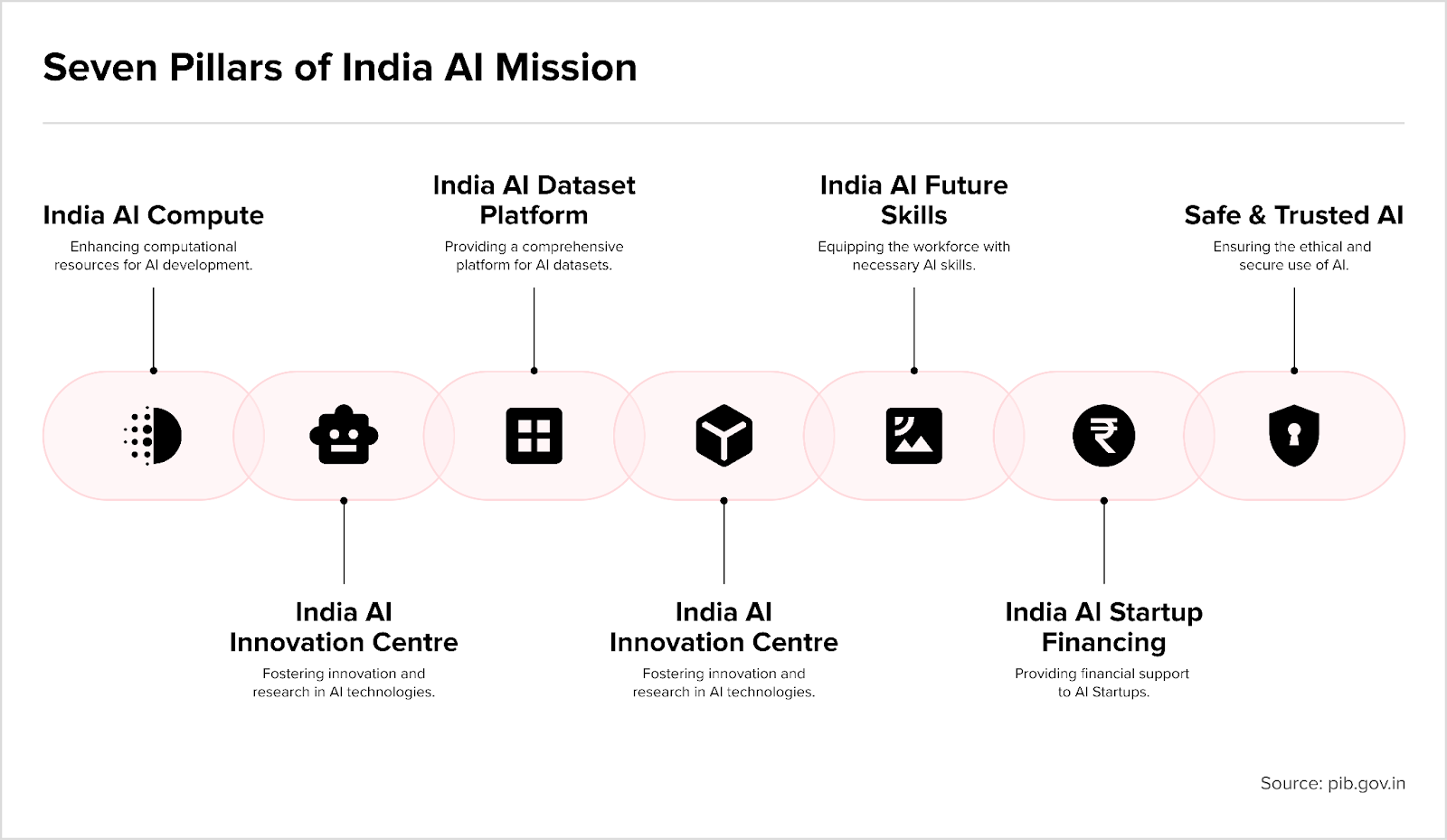
The plan points to stronger government support, more venture funding, global partnerships, and acquisitions by foreign tech.
Key AI themes and verticals in India
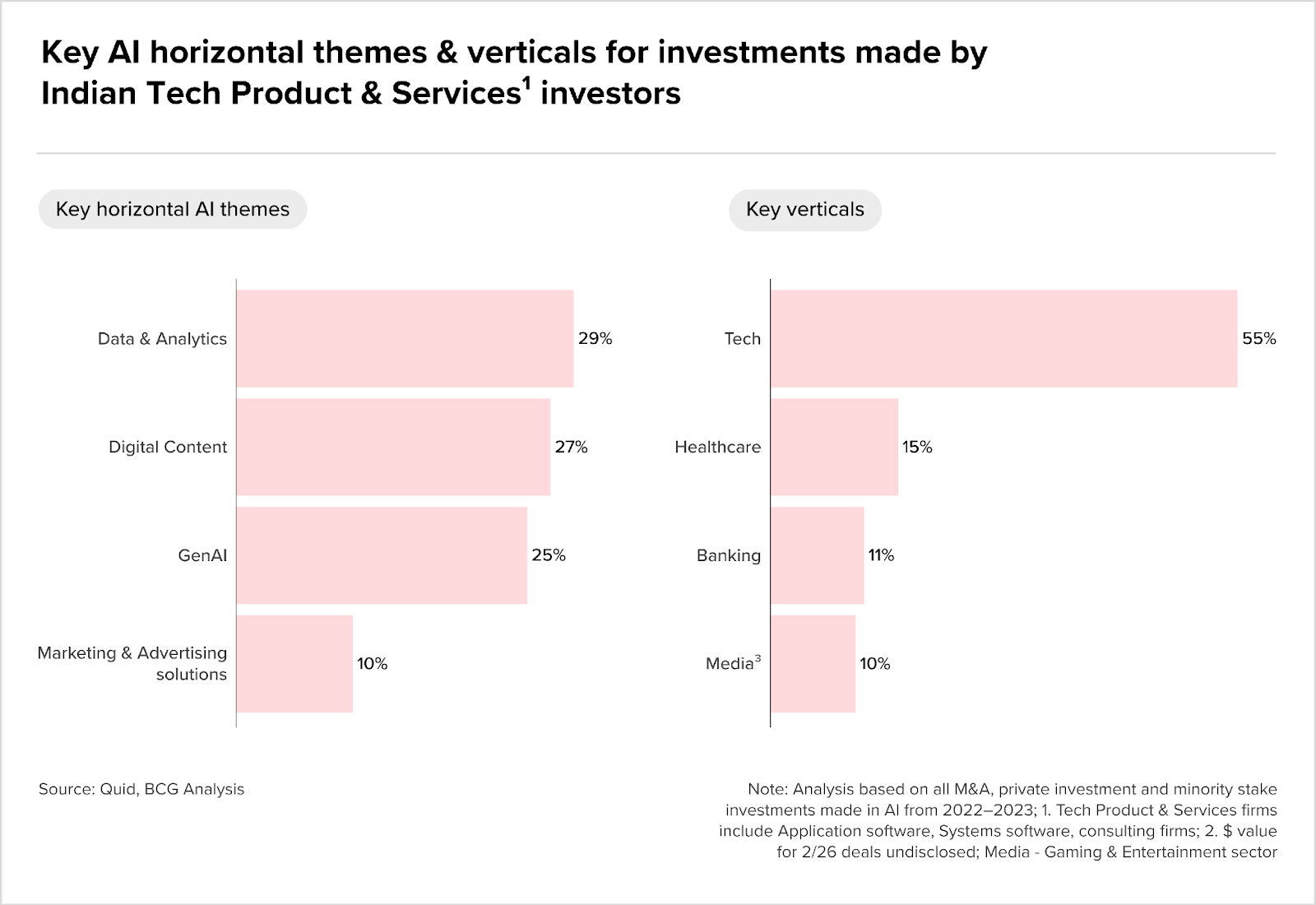
What, then, are the most prominent AI investment themes?
Looking horizontally there’s data and analytics at the largest share of 29% for the infrastructure and other enabling AI applications.
Digital content and generative AI follow closely, together representing more than half of AI-related investment activity.
The rise of generative AI as a major investment theme demonstrates how quickly tech moves from experiments and research to commercial deployment.
Tech companies dominate adoption with 55% of investment so far, exceeding other industries. But healthcare and banking represent the next most significant sectors, as both industries generate large datasets and benefit from predictive analytics and automation.
Media and entertainment also appear as emerging AI adopters, particularly through tools for digital content production, recommendation engines, and audience analytics.
For investors, the distribution suggests that India’s AI ecosystem is currently platform-centric, with technology firms driving the majority of innovation and investment.
Over time, however, the growth of sector-specific applications in healthcare, finance, and media is likely to create opportunities for vertical AI startups, partnerships with global technology companies, and acquisitions by larger enterprise software providers seeking to expand their AI capabilities.

The rumour mill
- Adani Ports confirms Israel-based Haifa Port infrastructure fully secure and operational amid conflict
- Fairfax Reportedly Leading Bid to Acquire IDBI Bank Stake
- India aims to cut thermal coal imports by 30% for power plants in 2026
- MTNL Receives Rs 10.86 Lakh Combined Fines from NSE and BSE for Board Composition Non-Compliance
- SCILAL Receives Rs 19.54 Lakh Regulatory Fines from BSE and NSE for Board Compliance Violations
- Oil India Fined ₹5.42 Lakh by BSE Over Board Composition Non-Compliance
- IFC mulls up to $50m investment in Indian non-bank lender SBFC Finance
- Central Bank of India CCI Approval Secured for Increased Stake in Generali Insurance Ventures
- RBI says 98.44% of withdrawn Rs 2,000 banknotes returned
- Motilal Oswal Home Finance Signs $100M ADB Deal for Women-Centric Green Housing
- Fewer women on board, less clarity on succession planning: What a survey of Indian PSUs found
- India assures uninterrupted oil product supply; crude diversification offers cushion
- Container freight from West Coast India to Middle East hits record high amid war
- In a volatile world, India’s healthcare remains a local growth story
- India’s Fino Payments Bank says transition to small finance lender on track
- Asia’s markets bear the brunt of Iran war as Korean stocks crash
- Iran war spurs emerging markets rout threatens investment case
- Vedanta Chairman Anil Agarwal urges 50% divestment in petroleum, mining sectors
- India:QBE Insurance Group to acquire full ownership of Raheja QBE General Insurance Company
- India gas importers start cutting supply to industrial customers
- Why Big AI is obsessed with India
- BHEL Receives ₹10.86 Lakh Fine from BSE and NSE for Board Composition Non-Compliance
M&A news
Job moves
- Shivakumar Dega resigns as independent director of Vadilal Industries
- Goyal Associates Limited Announces Resignation of Independent Director Hasmukh Prajapati
- MTNL Extends Additional Charge of Director (Finance) Post for Shri Rajiv Kumar
- Jio Platforms Limited appoints Dan Bailey as president to lead global expansion
- Punjab National Bank Appoints Debasish Gangopadhyay as Zonal Manager-GM in Senior Management Reshuffle
- Jio Platforms Appoints Dan Bailey as President for International Expansion
IPOs
Fundraising
- Inbound Capital, Outbound Ambition: India’s Cross-Border Investment Equation Enters a New Phase
- PE firms Trident, Amicus Capital lead funding in Indan electronics maker
- Global funds unwind hottest AI trades as inflation fears mount
- AIF rule reset widens access for accredited investors, raises new risk questions
- 23-year old founder’s home help app hits $100 million valuation
- Multi-Act set to roll out second fintech-focussed PE fund to enter private debt
Compliance/regulatory update
- NCLT approves Rs 700 cr resolution plan for Raigarh Champa Rail Infrastructure
- Punj Lloyd advances NCLT-backed sale of defence and aviation assets to Adani
- RBI’s power play to fire up mergers and acquisitions
- India, Japan can collaborate in chips, rare-earth & AI, says RBI chief
- India watchdog presses banks, other regulators for stricter insider trading enforcement
- Growing arbitrability in mergers & acquisitions: The need for minimal judicial involvement
- We expect policy rate to be at current level or lower for a long time: Sanjay Malhotra, Governor, RBI
- NCLT approves JSW Infra’s Rs 467 cr resolution plan for NCR Rail Infrastructure
- India’s IBC Slowdown Hits Tech Value: A Wake-Up Call?
- West Asia crisis: Rupee breaches 92 against $, RBI buys govt bonds
- RBI’s forward-book dollar deficit surges to $68.4 billion in January
- India’s rupee at record low as oil rise spikes regional meltdown
- RBI creates intervention space as Rupee faces renewed strain
- EU and India clinch ‘mother of all deals’ in rebuff to Trump
- India holds line on Russian oil with Trump’s tariffs in question
- India-Canada CEO Forum: PM Modi Highlights Reforms, Domestic Demand, And Investment Push
- India’s CAD widens to ₹13.2 billion in Q3 on higher trade deficit: RBI
- RBI processes 99.8% of Citizen’s Charter applications within timeline in February
- STC India Fined by BSE and NSE for SEBI LODR Non-Compliance – March 2026
- India manufacturing growth hits four-month high in February, PMI shows